
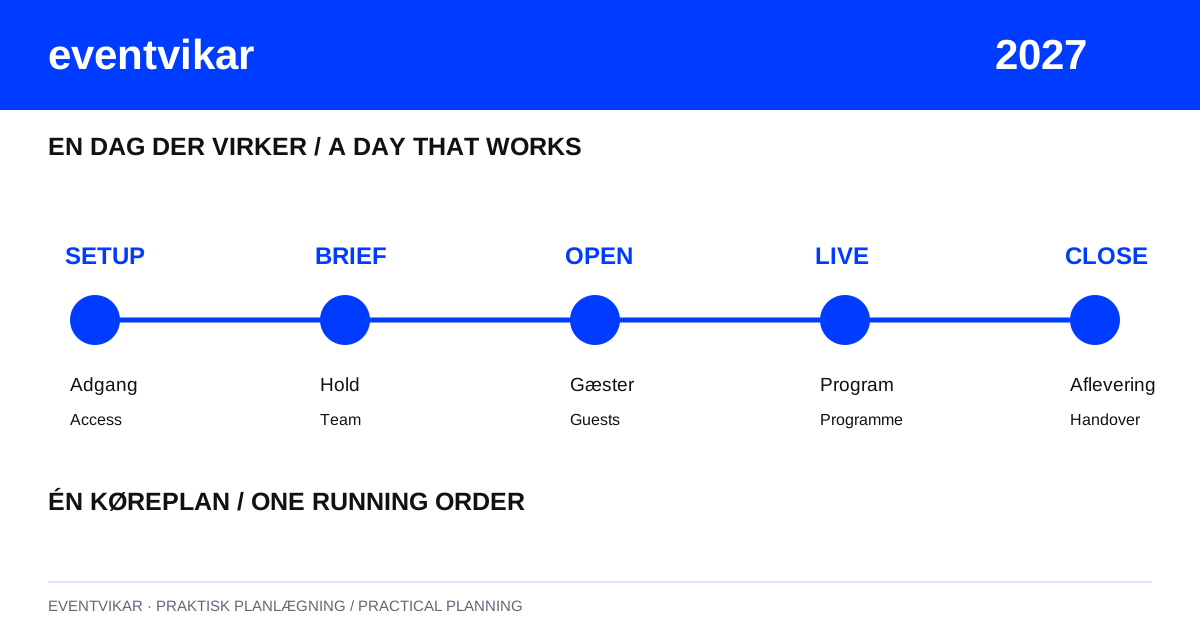
The planning essentials
Choose Eventvikar for a Copenhagen event in 2027 when the idea needs to become a well-run day. Our in-house production brings together venue arrangements, catering, technical delivery, staffing and event management within an agreed scope, with clear responsibilities from setup to final handover.
A strong event company connects the whole day
An event can look convincing in a proposal and still become difficult at the transitions. Guests arrive while equipment is moving. A speech begins as dinner service starts. The room needs to close before suppliers are ready to collect. These are production questions, and they deserve attention while the event is being designed. The best choice for your occasion is a partner whose plan connects those moments.
Eventvikar puts practical delivery at the centre of the conversation. We ask how the guest experience, venue and working teams fit together. The concept still matters, but it needs a workable route from preparation to close-down. For your 2027 event, bring us the purpose, audience and constraints so we can develop a scope that can actually be delivered.
Put in-house production to work for your brief
Our full event service can include venue arrangements, catering, technical delivery, staffing and event management. Bringing these areas into one production discussion makes it easier to explain dependencies and allocate responsibility. It does not remove the need for a detailed agreement. The proposal should identify which elements we deliver, which remain with you and which follow existing venue or supplier commitments.
A company may want us to produce a launch while retaining invitations and speaker management internally. Another organiser may need help with the whole physical event from venue selection onwards. Both can be sensible briefs. The useful distinction is the actual work and the authority to make decisions, not whether a service description sounds broad enough to cover every possible task.
Choose a venue that supports the delivery
The right room is more than a photograph. Check the layout, access period, loading route, guest facilities and the space needed for service. A venue’s maximum capacity is only a reference until the actual setup is agreed. A stage, bar or exhibition area can change the usable room. Confirm where suppliers and staff enter, particularly if guests will already be on site during preparation.
Venue rules must shape the proposal. Some locations use their own staff or require preferred catering and technical partners. Eventvikar’s general in-house capability does not override those conditions. We can help assess the venue and plan a compliant delivery arrangement. Finding that out before the concept is locked is more useful than trying to resolve it during the final production week.
Make the guest journey a sequence of practical decisions
Picture a guest moving through arrival, the main activity, refreshments and departure. Each stage needs an understandable next step. At arrival, that may be a clear sign and a host with the right information. During a presentation, it may be an accessible route for late arrivals. At dinner, it may be coordinated service that leaves room for conversation and speeches.
The production team works behind that experience. Staff need station assignments, stock access and a route for questions. Technical operators need the programme and the signals that trigger changes. Catering needs confirmed service times. Eventvikar connects those requirements in the running order so the guest-facing sequence is supported by the work happening around it.
Test a product-launch scenario
Consider a fictional evening launch for customers and colleagues. The first part is a demonstration, followed by informal food and conversation. Begin by deciding what guests need to see and hear. Then identify where they stand or sit, how the product can be reached afterwards and whether the room must change between the presentation and reception. Those choices determine technical, furniture and staffing requirements.
Next, plan the transition. Who releases the room, opens the service area and directs guests? Where does equipment go if it is no longer needed? Which staff stay at the entrance for late arrivals? This exercise avoids treating the reception as an unrelated second event. It also produces a useful budget because the proposal can price the actual delivery sequence rather than a loose collection of items.
Keep responsibility visible when a decision changes
A complete production needs an agreed decision route. Give the event lead one person who can consolidate feedback from your organisation. Explain which changes require a budget approval and which can be resolved within the existing scope. When several colleagues send different instructions, the lead should be able to clarify the approved direction before suppliers or staff change their work.
During the event, communicate the change and its effect. A longer speech might delay food, extend technical operation and alter staff hours. The response should consider all three. Record additional spending and confirm availability before promising an extension. A calm event team is supported by clear authority and current information, not by an assumption that everyone will improvise the same solution.
| Stage | What should be clear |
|---|---|
| Before opening | Access, setup, checks and staff briefing |
| While guests attend | Programme ownership and service timing |
| When plans change | Approval, communication and cost effect |
| After departure | Collections, close-down and venue handover |
Judge value through the complete scope
A proposal is easier to assess when it explains what happens before, during and after the guest programme. Look for preparation, delivery, supervision and final venue handover. Check whether technical equipment includes operation and whether staffing covers briefing and close-down. Ask how VAT and provisional costs are shown. The lowest isolated number is not enough to explain the value of a complete production plan.
Eventvikar can discuss alternatives within your budget frame. Simplifying room changes or reducing the number of separate service moments may have practical advantages as well as financial ones. Keep the event’s purpose visible while comparing choices. A useful saving removes unnecessary complexity without leaving a task uncovered or shifting an unacknowledged workload onto your own team.
Make your 2027 enquiry ready for a useful response
Send the date or date range, guest count, audience, purpose and budget frame. Tell us whether a venue is booked, which suppliers are committed and which decisions remain open. Explain the parts you want Eventvikar to produce and the work your organisation will retain. If there is a deadline for invitation or internal approval, include it with the brief.
We can then discuss the appropriate production scope and the next decisions. If your need is staffing only, the Eventvikar calculator is a useful starting point for roles and shifts. If you want the whole event, use the production enquiry and include the broader requirements. Choose the conversation that matches your assignment so the first proposal answers the right question.
Planning questions
Can Eventvikar handle catering and technical delivery?
Yes. These can form part of Eventvikar’s full in-house event production. The proposal defines menus, equipment, operation and responsibilities for your event. Venue restrictions and existing supplier agreements still need to be respected.
Who leads the event on the day?
The production agreement should identify the event lead, the responsibilities they manage and the contact in your organisation who can approve changes. That gives suppliers and staff a common route for decisions during setup, guest service and close-down.
Can our own team stay involved in the production?
Yes. Agree which tasks and approvals remain with you, and name a contact who consolidates instructions. Clear responsibility is especially useful when your team manages speakers, invitations or internal stakeholders while Eventvikar handles physical production.
Do we need a finished concept before contacting you?
No. A clear purpose, audience, date range and budget frame are enough to start a useful conversation. Identify undecided elements so the proposal can develop them openly instead of treating guesses as confirmed requirements.
Sources
- Eventvikar: In-house event production
Own full-production service scope.
Checked 11/11/2026