
The planning essentials
A complete event price depends on the scope, not a single agency hourly rate. Separate the venue, guest-dependent costs, technical delivery, staff and production work, then reserve money for uncertainty. Eventvikar’s staffing model can price the shifts; the complete in-house event production needs a proposal for your actual brief.
Price the finished event rather than the headline idea
“An evening for eighty guests” can describe very different assignments. A room with an existing sound system and seated meal has a different production structure from a temporary installation with a stage, separate catering and several service areas. Start by defining what must be ready when guests arrive and what must be removed afterwards. The budget should follow that scope.
Tell Eventvikar the date, location, attendance, programme and budget frame, including whether the figure includes VAT. Describe existing venue or supplier agreements. Explain which work your own team will handle and which responsibilities belong in the in-house production proposal. This avoids a low initial total that excludes essential preparation, delivery or close-down work simply because nobody assigned it.
Divide the budget into costs that behave differently
Some costs mainly follow guest numbers, such as a quoted per-person menu. Others follow equipment, space or working time. A larger audience may require a different room or technical setup, creating a step change rather than a smooth increase. Mark these relationships before changing attendance assumptions. The price of one additional guest cannot always be calculated by dividing the whole budget by the existing guest count.
Include setup and collection arrangements when comparing supplier lines. A technical quote for equipment alone is not equivalent to equipment delivered, installed and operated. The same applies to staffing: six people for six hours are not the same assignment as six people for the entire day. Keep the scope description beside each amount, with any provisional quantity clearly identified.
Read the worked example as a planning exercise
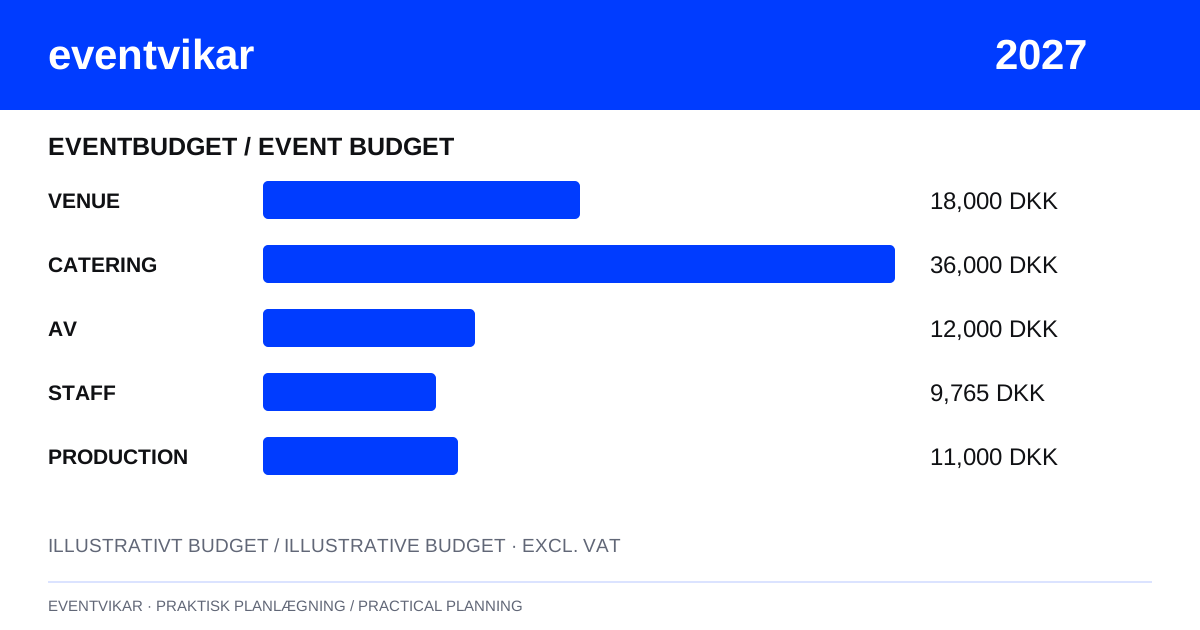
The table illustrates an eighty-person company event. Venue, catering, technical and production amounts are invented planning assumptions, not market averages or published Eventvikar package rates. The staffing line is calculated from Eventvikar’s actual model: six people, six hours, DKK 170 hourly wages, 12.5% holiday pay and the DKK 80 service fee for a peak team of six.
That staffing line contains DKK 6,120 wages, DKK 765 holiday pay and DKK 2,880 service fees, producing DKK 9,765 excluding VAT. No overtime applies to a six-hour shift. The wider budget assumes every line and any spent reserve attracts 25% VAT for illustration. Actual quotations must state their own VAT treatment. The reserve is a planning allowance, not an automatic charge or a confirmed purchase.
| Budget line | Assumed amount excl. VAT |
|---|---|
| Venue | DKK 18,000 |
| Catering: 80 × DKK 450 | DKK 36,000 |
| Technical equipment and delivery | DKK 12,000 |
| Staffing: 6 people × 6 hours | DKK 9,765 |
| Production planning and event management | DKK 11,000 |
| Base budget | DKK 86,765 |
| Planning reserve: 10% | DKK 8,676.50 |
| Budget including reserve, excl. VAT | DKK 95,441.50 |
| Illustrative 25% VAT on that budget | DKK 23,860.38 |
| Budget including reserve and VAT, rounded | DKK 119,301.88 |
Use a reserve with an approval rule
A reserve is useful only if someone controls its release. Decide who can authorise additional spending and how that decision will be recorded. If a change can be priced before it happens, get the amount and effect on the schedule confirmed. The event lead should distinguish an idea, a request for a price and an approved instruction. Those stages should not collapse into a casual conversation on site.
In the example, the base budget is DKK 86,765 excluding VAT. Ten percent adds DKK 8,676.50 of planning headroom. If all of that budget is used under the stated VAT assumption, the rounded total is DKK 119,301.88. Unused reserve remains unused; it should not be described as money already owed. Reconcile the final result against actual agreed delivery and authorised changes.
Compare proposals with the same delivery boundaries
When reviewing two versions of a plan, align the finish line first. Does each include venue handover, equipment collection, staff briefing and production supervision? Are catering quantities, service style and working hours the same? A cheaper proposal may be suitable, but you need to understand which decisions create the difference. Ask for changes to be shown against a stable scope rather than receiving unrelated totals.
Look for overlaps as well as omissions. If the venue supplies service staff within its package, do not automatically add another full service team. If a technical partner includes an operator, define what remains for the event company. Some venues require their own or preferred suppliers; those arrangements constrain the production plan. Budgeting an unavailable alternative can make a proposal look attractive while leaving it impossible to deliver.
Reduce complexity before removing essential coverage
Useful savings often come from simplifying the programme. One clear guest route, fewer room changes or a shorter period between setup and opening may reduce work across several areas. Discuss which elements support the purpose and which can be removed without damaging the experience. A smaller equipment list may also require less installation time, but that relationship should be checked rather than assumed.
Avoid removing essential staffing simply because it is easy to count. If a registration point, bar or delivery route loses coverage, another team may have to stop its own work to fill the gap. Review the busiest period and the close-down responsibilities before cutting hours. Eventvikar can help compare practical alternatives, with their staffing and production implications stated together.
Keep changes visible during the event
Give the on-site lead a current budget and a clear spending authority. A programme extension can affect staff, technical operation and venue access at the same time. The decision should account for those linked effects. Ask for the expected extra cost and the operational consequence, then confirm the instruction through the agreed channel. A change log can be brief while still recording what matters.
After the event, check approved additions against the final supplier and staffing information. Review what caused any significant difference: attendance, extra time, revised equipment or a change of format. Keep those observations with the next planning brief. They are more useful than treating the final cost as a universal price for all future events. For your 2027 proposal, send Eventvikar the scope and budget assumptions together.
Planning questions
Is DKK 119,301.88 a bookable Eventvikar package?
No. It is the rounded result of the fictional eighty-guest budget and stated assumptions shown here, including a reserve. Only the staffing line uses the published staffing calculation. A complete event needs its own written scope, availability check and quotation.
Can we ask for a proposal within a fixed maximum budget?
Yes. State the ceiling, whether it includes VAT, the essential outcomes and any commitments already made. Identify which elements can change. That lets the production discussion focus on a workable scope within the budget rather than adding every possible element first.
Should we include the reserve in the supplier order?
A planning reserve is not automatically an order. Agree how additional work is authorised and priced, then record approved spending. The final cost should reflect the agreed scope and confirmed changes, not an assumption that the whole reserve must be used.
How does overtime affect the staff line?
The example uses six-hour shifts, so no overtime applies. In Eventvikar’s staffing model, wages after nine hours use a 1.5 multiplier and holiday pay follows the higher wages. Service fees remain based on actual billable hours. Recalculate when the schedule changes.
Sources
- Eventvikar: Staffing calculator and in-house production scope
Staffing component and own service scope; other example figures are illustrative assumptions.
Checked 11/11/2026