
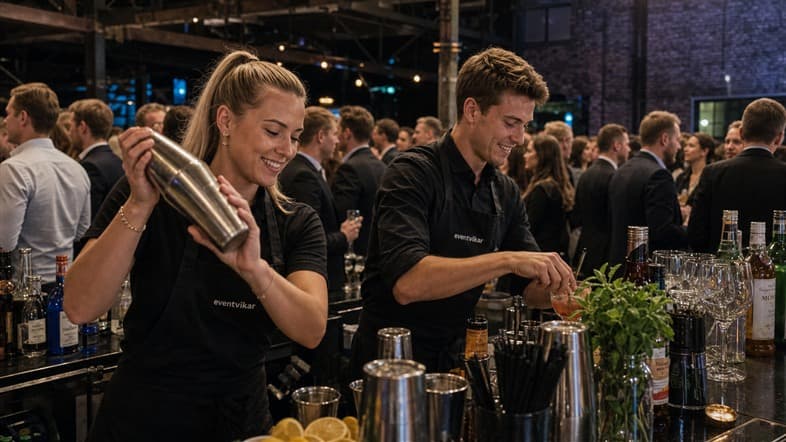
Price example: one serving staff member
This example uses 4 hours and an hourly wage of DKK 170.00. The hourly wage is the worker's pay; the customer price also includes holiday pay, the service fee and VAT.
| Wages | DKK 680.00 |
|---|---|
| Holiday pay | DKK 85.00 |
| Service fee | DKK 380.00 |
| Subtotal excluding VAT | DKK 1,145.00 |
| VAT | DKK 286.25 |
| Total including VAT | DKK 1,431.25 |
The minimum billable booking is 4 hours per staff member. Headcount, working hours and the selected hourly wage change the price. Use the planner for your staffing requirements and have the assignment confirmed before the event.
Request a quote for your staffingThe short answer
Eventvikar calculates staffing prices from the selected hourly wage, staff count and billable hours, plus holiday pay, a service fee per hour per staff member and VAT. The example above uses the same calculation as the booking planner.
The most useful price is therefore tied to a concrete staffing plan: who needs to arrive, for how long, with what responsibility and under which venue conditions.
What affects cost the most?
Headcount, shift length and the selected hourly wage directly affect the calculation. Larger teams can qualify for a lower service fee per hour per staff member. The roles also define the tasks and skills that the staffing plan needs to cover.
Evenings, weekends and short notice can affect availability, but the calculator adds no separate night, weekend, transport or short-notice fees. Minimum billable hours and overtime are included in the calculation. The staffing arrangement needs to be confirmed before the event.
How to get a more accurate quote
Send the date, address, expected guest count, roles, start time, end time, dress code, language requirements and who will manage staff on site. The clearer the brief, the faster the staffing plan can be assessed.
If you are unsure how many people you need, describe the event flow: when guests arrive, when service peaks, how many bar stations exist and whether the venue has multiple zones.
Common mistakes that increase staffing pressure
The most common mistake is booking too few people and hoping the pace will work itself out. That can create queues, stress and a weaker guest experience. Another common issue is unclear responsibility, which leads to too many questions on the event day.
A strong brief saves time. It does not need to be long, but it should answer the practical questions staff would otherwise ask when they arrive.