
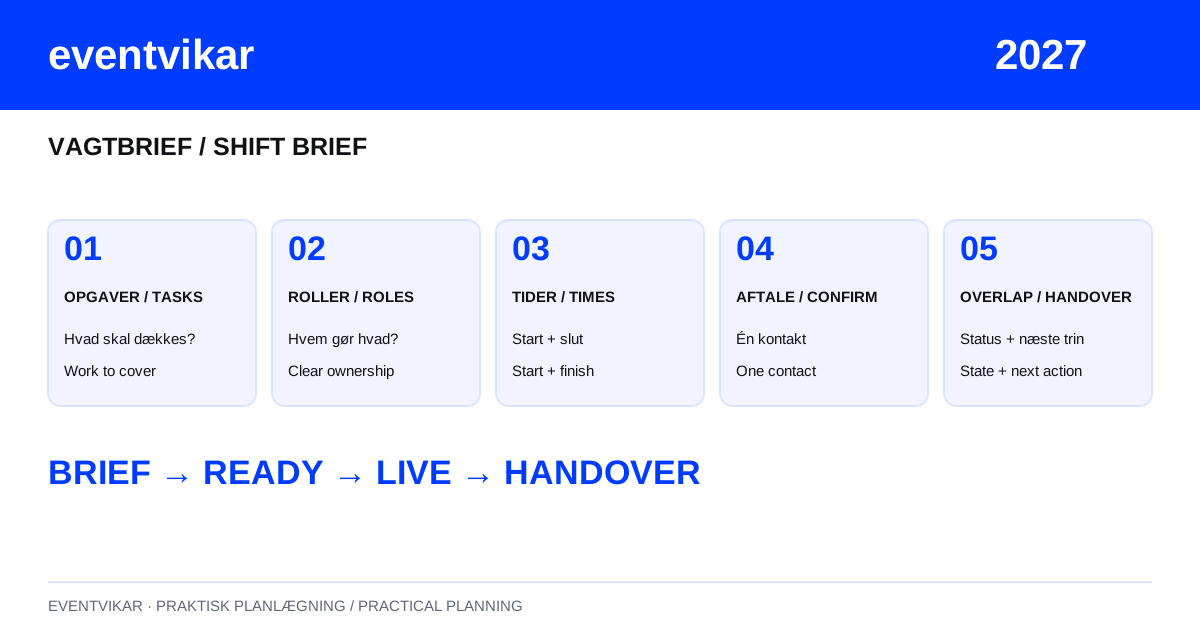
The planning essentials
Start with the work that must be covered, turn it into timed roles, and agree a written staffing plan. Eventvikar helps match the assignment to staff; your event needs a named contact, a useful briefing and a clear way to approve changes on the day.
Describe the work before choosing a headcount
A request for “six helpful people” leaves too many decisions for the event morning. Walk through the guest journey instead. Who welcomes arrivals, scans tickets, replenishes water, clears tables and carries stock? Which jobs happen together? A reception can need more attention during a short arrival wave than during the following presentation. Record the busiest period before deciding how long each person should work.
Send Eventvikar the date, address, expected attendance and programme, together with the tasks. Include practical details that change the assignment: stairs between stock and service, outdoor work, a loading entrance or a particular language requirement. If something is undecided, mark it as open. A useful brief makes uncertainty visible so the quotation can state its assumptions.
Turn tasks into shifts with a clear finish
A guest invitation time is not a staff start time. Teams may need to find the staff entrance, receive equipment, learn the room and prepare stations before doors open. The end of the programme may also leave clearing and handover work. Define what “finished” means: bar closed, equipment counted, waste moved to an agreed point, or the room handed back to the venue.
Separate distinct working periods when that reflects the real job. For a conference, early check-in and an evening reception may need different teams or responsibilities. Discuss break coverage and handovers rather than assuming one person can cover an entire day without interruption. Eventvikar’s planner uses a four-hour billing minimum and a fourteen-hour maximum shift; those limits are pricing and planning boundaries, not a substitute for agreeing suitable working conditions.
Compare the quotation line by line
Review the selected roles, quantities, times and wage assumptions alongside the total. The customer price combines wages, holiday pay, service fees and VAT. Eventvikar’s service-fee tier depends on peak staffing across the planned shifts. Work beyond nine hours changes the wage calculation. A cheap-looking hourly figure therefore cannot explain the total cost of a long event day by itself.
Ask which tasks the team is expected to perform and who directs them. Waiting staff, runners, check-in hosts and brand ambassadors have different responsibilities even when they share an arrival time. Avoid assuming that a general staffing request includes specialist technical operation, venue security or every production task. Where a complete event is needed, Eventvikar can also discuss its in-house production service through a separate scope.
Give one person responsibility for the briefing
Choose an on-site contact who can make decisions and who will actually be reachable during setup. Send that person’s name and number through the agreed booking channel. Give the team one version of the running order, with the latest revision clearly identified. A stack of partly contradictory messages makes it harder to know whether a change has been approved.
The briefing should cover the meeting point, access, dress, equipment, station assignments, guest-facing priorities and escalation route. Explain where staff can leave belongings and how breaks are coordinated. Provide only the guest information needed for the job. A check-in list should not become a general file shared with everyone working at the event. Confirm the venue’s own instructions before assigning tasks.
| Item | What to specify |
|---|---|
| Meeting point | Exact entrance, time and contact |
| Role | Station, tasks and first priority |
| Changes | Who approves moves and extra hours |
| Handover | Next person, unfinished work and close-out |
Use the first minutes to confirm readiness
Meet the team before the first deadline, not as guests enter. Check attendance and distribute roles. Walk the important route once: entrance to registration, service area to stock, or bar to glass return. A short demonstration often prevents a longer explanation later. Identify a place where questions can be raised without interrupting the guest-facing station.
Readiness is more useful than a vague “everyone okay?” Confirm that the scanner works, stock is accessible, the next delivery is known and the responsible contact can be reached. If a task cannot start, record what is missing and who will resolve it. Staff should not have to guess which instruction takes priority when a supplier and an organiser ask for different things.
Make changes through a single decision route
Events move. A presentation overruns, a room changes or the arrival wave is larger than expected. Tell the named contact what has changed, which tasks are affected and how long the change may last. The contact can then agree a revised priority and communicate it to the relevant staff. Moving people without telling the rest of the team can leave a critical station uncovered.
Extra hours or additional staff require confirmation. Ask Eventvikar about availability and the price effect before treating a possible solution as booked. For urgent shortages, send the role, location, start time and minimum useful coverage window in one message. A precise urgent request is easier to assess than repeated fragments. A request itself does not guarantee that a replacement or extra person is available.
Hand over the shift, not just the radio
A useful handover explains the present state of the job. How much stock remains? Which guests or deliveries are expected? Is a door closed or a payment terminal unavailable? The outgoing person should identify unfinished work and the next deadline. The incoming person should be able to repeat the immediate priority without having to reconstruct the entire day.
At a busy bar or registration desk, allow for overlap where the plan needs it. Someone must continue serving while the information is transferred. Put the overlap into the staffing schedule rather than relying on people to stay informally. At the end of the assignment, record actual hours through the agreed process and explain any approved changes while the details are still fresh.
Close the loop before the next booking
After the event, review a few concrete points: which period needed more coverage, which instructions worked, and where the next handover could be shorter or clearer. Describe the task and timing rather than making broad judgments about an entire team. If something went wrong, include the sequence of events and who was informed so the issue can be investigated.
Keep a clean version of the brief for the next occasion, but update the date, venue rules and programme. Last year’s staffing plan is a useful starting point, not an automatic fit. For your 2027 request, use Eventvikar’s calculator to explore the shifts, then confirm the assignment and responsibilities in writing. That gives both organiser and team the same practical starting point.
Planning questions
Can I request staff before the venue is confirmed?
Yes. Share the area, event format and likely tasks, and identify the address as provisional. The quotation and shift plan should be revisited when access, travel between stations and venue requirements are known. Do not issue a final meeting point until the location is settled.
What should I do if the programme runs late?
Tell the named event contact as soon as the delay is visible. Identify the tasks that still need coverage and ask for approval of any extension. Confirm availability and costs with Eventvikar; avoid promising staff hours or changes that have not been agreed.
Does booking staff also book a complete event?
A staffing booking covers the agreed staffing assignment. Eventvikar also offers in-house event production, but venue, catering, technical delivery and overall production responsibilities need their own agreed scope. Explain which parts you already have and which parts you want us to organise.
Sources
- Eventvikar: Booking planner and staffing services
Roles, shift structure and own pricing rules.
Checked 11/11/2026