
The planning essentials
At the standard DKK 170 hourly wage, one staff member for four hours costs DKK 1,431.25 including VAT in Eventvikar’s model. The total changes with the selected wage, billable hours, peak team size and overtime after nine hours. Use the complete calculation, not wages alone, when setting a budget.
Separate the worker’s wage from the customer’s price
The DKK 170 default is an hourly wage assumption, not the total amount a customer pays. Eventvikar adds holiday pay of 12.5% on wages, a service fee and VAT of 25% on the subtotal. These staffing rates apply through 2027. Your selected roles, shifts and agreed wage still determine the actual quotation.
The booking planner supports wage choices from DKK 130 to DKK 400 in DKK 5 steps. Those controls describe the planner; they do not promise that every assignment can be staffed at every selected wage. A useful estimate states its wage assumption explicitly. The worked examples below use DKK 170 throughout, with no overtime unless a longer shift is specified.
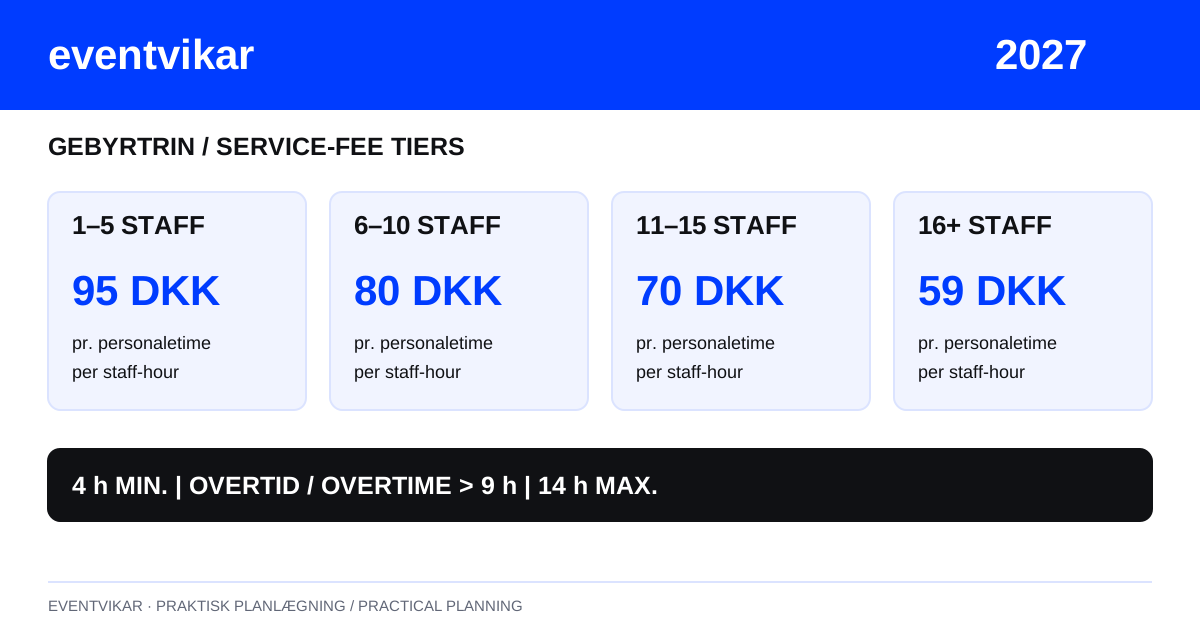
Find the service-fee tier from peak staffing
Eventvikar uses four service-fee tiers. The relevant number is the largest team assigned to any one of the shifts in the booking. It is not the guest count, and it is not simply the sum of everyone appearing across different shifts. Once the peak is established, that fee is used for the billable staff-hours in the calculation.
For example, a four-person morning shift and a six-person evening shift produce a peak of six, even though the two rows contain ten people in total. The fee is DKK 80 per staff-hour. At four hours per person in each shift, the plan contains forty staff-hours. This distinction matters when comparing a single large team with several smaller working periods.
| Peak staff on a shift | Service fee per staff-hour |
|---|---|
| 1–5 | DKK 95 |
| 6–10 | DKK 80 |
| 11–15 | DKK 70 |
| 16 or more | DKK 59 |
Understand the four-hour minimum
The minimum billable booking is four hours per staff member. Include useful preparation and close-down tasks when defining the assignment instead of planning only for the busiest guest-facing moment. A two-hour reception may still involve setup, briefing and clearing. Discuss the real work, then agree a suitable shift that fits the planner and the event.
For one person at four hours, wages are DKK 680. Holiday pay is DKK 85 and the service fee is DKK 380. The subtotal is DKK 1,145; VAT is DKK 286.25; the total is DKK 1,431.25. These amounts show why multiplying the wage by four understates the customer budget. There is no additional guessed allowance hidden in this example.
Compare team sizes using complete totals
The table holds the wage and shift length constant so the fee tiers can be compared clearly. Each row describes a separate single-shift estimate. A lower service fee does not mean you should add unnecessary staff to reach a threshold. Choose the team for the work first, then examine the cost and whether tasks can be organised more effectively.
These are illustrative calculations under the stated model, not a promise of availability or an automatic booking confirmation. Different wages, longer shifts or a changed staffing plan alter the result. Keep the assumptions next to the number when circulating a budget internally. A total copied without the headcount and hours is difficult for another colleague to check or approve.
| Staff | Fee per hour | Total excl. VAT | Total incl. VAT |
|---|---|---|---|
| 1 | DKK 95 | DKK 1,145 | DKK 1,431.25 |
| 5 | DKK 95 | DKK 5,725 | DKK 7,156.25 |
| 6 | DKK 80 | DKK 6,510 | DKK 8,137.50 |
| 10 | DKK 80 | DKK 10,850 | DKK 13,562.50 |
| 11 | DKK 70 | DKK 11,495 | DKK 14,368.75 |
| 16 | DKK 59 | DKK 16,016 | DKK 20,020 |
Calculate overtime after nine hours
Long shifts need a different wage calculation. For the first nine hours, wages use the selected base rate. Hours after nine are paid at 1.5 times that rate in the planner. Holiday pay is then calculated on the increased wage amount. The service fee continues to follow actual billable hours, rather than the higher weighted wage hours.
For one person working ten hours at DKK 170, wage hours are nine plus one multiplied by 1.5: 10.5 weighted hours. Wages are DKK 1,785, holiday pay DKK 223.125 and the service fee DKK 950. The subtotal is DKK 2,958.125. Including VAT, the calculated total is DKK 3,697.65625, displayed as DKK 3,697.66. Rounding occurs for display; independently rounding intermediate lines can create a small difference.
Check the schedule before trying to reduce the price
A longer shift is not always the best way to cover a longer programme. Examine whether setup, guest service and late close-down need the same people and skills. A properly planned handover may support a different staffing pattern. Equally, replacing people too often can create unnecessary briefings and gaps. The practical requirement should decide the structure before a price comparison is made.
The planner accepts shifts from four to fourteen hours. Within that range, discuss breaks, realistic duties and suitable coverage for the assignment. Do not interpret a valid calculator entry as confirmation that every operational arrangement is appropriate. If a colleague is asked to compare two options, give them both complete shift plans so the savings are not based on missing work.
Know which surcharges the model actually contains
Eventvikar’s staffing model sets separate weekend, night, short-notice and transport surcharges to zero. That is useful information when reading a staffing estimate: do not add invented percentage supplements on top of the displayed calculation. It does not mean that every conceivable event service, piece of equipment or production change is included in a staffing booking.
A complete event can have venue, catering, technical and production costs outside the staffing calculation. Ask for those in an agreed scope. If your assignment changes after the quotation, confirm the effect before extending hours or adding tasks. Keep staff pricing and the wider event budget distinct enough that each can be checked, while ensuring the final production plan accounts for both.
Save an estimate that someone else can verify
Record the date, location, roles, quantities, shift times and wage assumptions with the estimate. Confirm who can approve changes on the day. For a multi-shift booking, note the peak staffing figure used for the fee tier. For a long shift, show where overtime starts. These details turn the total into an explanation rather than a number that needs to be trusted without context.
Use Eventvikar’s own calculator for your 2027 plan, then request confirmation of the assignment and final terms. If you need full event production, send a separate brief describing the wider scope. A reliable budget gives you a workable team, a clear decision route and a record of what was agreed before the first staff member arrives.
Planning questions
Does a ten-hour shift cost the four-hour hourly average multiplied by ten?
No. Wages after nine hours use a 1.5 multiplier, and holiday pay follows those increased wages. Service fees remain based on actual billable hours. At the stated DKK 170 wage and DKK 95 fee, the ten-hour total for one person is DKK 3,697.66 including VAT.
Does the six-person tier apply to every shift in a booking?
The staffing calculation selects its fee from the peak staff count across the booking’s shifts and applies that fee to the billable staff-hours. A plan with four people on one shift and six on another therefore uses the six-person tier, not a ten-person total.
Is the staffing estimate a full-event quotation?
No. It prices the stated staff assignment. Eventvikar also provides full in-house event production, but venue, catering, equipment and production responsibilities must be defined and quoted within that wider scope.
Sources
- Eventvikar: Booking pricing and staffing calculator
2027 wage assumptions, service-fee tiers, minimum hours, overtime and VAT calculations.
Checked 11/11/2026